8 Articles for 'Google'
- 2009/12/07 Google Korea Unveils New Homepage (4)
- 2009/02/27 "Naver California"? (2)
- 2008/09/12 We've been Googled! (36)
- 2008/09/01 Naver Japan announces what it's up to, finally after 3 years
- 2008/04/16 So Google China hopes to become #1 within 5 years - where will that leave Google Korea?
- 2008/04/01 April Fool's Day joke of a Korean web startup (1)
- 2008/01/17 Google now #2 in Japan
- 2006/05/05 What will be Google Korea's next move?
Discaimer: Google is my current employer. This post is purely personal and therefore does not represent the company's official voice in any ways whatsoever.
Google Korea has that radically breaks out of the company's trademark scantiness. Google's Korean homepage now displays more content right up on its front page, featuring popular search keywords, most searched-for people ("who's hot"), and the directory of Google Korea's services.
What's most interesting on Google Korea's homepage is machine-produced "topical search keywords". Google looks at what topics people are most interested in, and present those topics as search keywords in the form of short headlines. (This is purely algorithmic and no human efforts are involved in the whole process.) This way, viewers are immediately drawn into the subjects and are likely to click on the headlines -- by doing which they are essentially undertaking internet search on Google. In Korea, much of internet search is done this way, meaning browsing through links and clicking on interesting ones, as opposed to entering fresh search keywords into the search box. (Not that the latter is nonexistent, though.)
Korean blogosphere seems to be torn on this "portalization" of Google Korea's homepage. Some like it, saying Koreans should give credit to Google Korea for its efforts to radically customize its global service to better suit the local needs. Others say Google Korea may lose its identity, and this catch-up game won't help Google to overcome the local incumbents.
It remains to be seen if Google Korea's move will help or hurt the company to gain more turf in this tough Korean market, but one thing is very clear: This is a very big move by Google. This new, content-rich homepage is only available in Korea -- and this is worlds apart from Google's . In a way, this shows Google is very much committed to the Korean market, even to the point where the company is willing to ditch its hallmark simpleness, something many in and out of the company has long regarded to be near impossible. Will Koreans like this move and pay more visit to Google Korea for their internet search? The jury is still very much out.
TAG ,

A recent article by the Economist notices yet again Naver's success in the Korean market. Naver's total domination in Korea hardly surprises anyone, but what was quite interesting was Naver's ambition to launch in other countries including the US.
... Mr. Chae [Naver CEO] says he plans to launch several more culturally specific search engines, such as “Naver California”, “Naver Korean-American” or “Naver Chinese-American”. That would be attacking Google on its home turf. Is this too ambitious? Naver say never.
Attacking Google on its home turf? Wow, when was the last time someone even dared to think about it?
So is Google now supposed to be shaken to its knees? Perhaps not yet. But don't label this as an absurdly far-fetched idea just yet. Remember Naver's tactic wouldn't be a head-on collision with Google.
Though both are called search, Naver and Google are quite different species. Naver's forte is in aggregating useful information for popular topics, often created by the users themselves (blogs and Q&A searches), and presenting such information in a very human-friendly way (heard "universal search"?). Unlike Google, Naver doesn't rely almost entirely on the brute force performance of its search algorithm.
Some users may prefer Naver's approach to search - which is what Naver hopes would be the case for the Japanese, the first foreign market the company is targeting at and putting lots of efforts in. If Naver can make a visible dent in the Japanese search market, it will then go to China, and then... who knows where else. Which is what makes Naver's Japan search, reported to be imminent to launch, all the more important.
Disclaimer: The contents in this post may pertain to the author's personal interests.
They say "All good things come in threes" - well, the year 2008 was the living proof of that phrase for me. Firstly, Sara and I had our first baby son, Issac, who is our biggest blessing. Secondly, Open Web Asia '08, the premier web conference that I started as a personal project but has since been a great community effort of more than a dozen web professionals, is looking more and more like a hit conference with about 20 top-notch speakers. (Register away!)
And, to borrow Steve Jobs's patent line from his keynote, there's "one last thing" - our company was acquired by Google.
Who we are and why (I think) Google bought us

Despite the danger of sounding too self-important, I would say our company was a fairly good acquisition target for Google. First, we had a killer product: Our previous work, Tistory blog service (now property of Daum as we sold the service to the Korea's #2 portal), made to the top 10 Korean web destination in less than a year from launch, showing some 30,000% growth over the initial 8 months. While other blog services seem to be exploring the idea of integrating social networks with blogs only lately, our new blog service Textcube (link in Korean) had already implemented the feature much earlier. Secondly, we have great engineering talents. Many of our software engineers hail from the nation's leading comp sci programs, such as KAIST.
Significance: Google takes Korean market seriously
Some might say what's the big deal here, as Google seems to acquire companies almost daily. Well, if I may put some meaning to this deal, the notable fact here is that we are a company based out of Korea. To my knowledge, we are being one of the first major acquisitions done by Google in the entire Asia let alone Korea, if we don't count Austrailia and also exclude share-taking activities in China for licensing purposes. Of course I could be totally wrong, as Google doesn't annnounce all its acquisitions.
Speaking of Google in Asia, one piece of fact that my American friends have really hard time perceiving is that Google is an underdog in this part of the globe. Korea is the world's sixth largest market in terms of internet users, and yet Google has a market share that can only be described as "minor" in Korea.
Why? Korean web users mostly use Yahoo-like "portal" services and never really venture out. Part of the reason for that is, Korean portals are so good. But portals have built too thick of a comfort zone for Korean web users, leaving little room for startup innovations. Hence less motivation for startups, hence less diversity and more portal domination (in this age of de-portalization, that is), and so on and so forth - the cycle goes on.
What we will do
Now as a part of Google, TNC will try to better the situation. We will commit ourselves to increasing Google's market share in Korea. Of course, Google isn't entitled with God-given right to become #1 in every region it operates in, just because it's Google. It's actually more about the Korean web industry than about Google. I think the Korean web industry needs a player that can, as a balancing force, provide more options to the users and help create a more open web. Well, who can be that player? How about giving a chance to a company that sincerely strives to be "not evil" despite its sheer bigness?
Perhaps fitting with my personal vision (which is also a motivation behind the Open Web Asia conference and this very blog), we will also try to introduce Textcube to outside of Korea. Textcube was so good that it was called "better than the services in the US in many ways" by some international media like Giga Om, but we were hopelessly behind in terms of globalizing our product, with my perennial excuse that I'm too busy with the Korean market alone. Hopefully Google's global presence will be of tremendous help in globalizing Textcube and other interesting web services coming from Korea.
PS.
1) For the deal specifics, as many of you should know well, by confidentiality agreement I am not supposed to talk anything about the deal, so you don't have to bother asking. :)
2) I would like to take this opportunity to thank my partner, Chester Roh. He's been extremely good to work with. If I hadn't met him back in 2004, I would still be pushing papers at a cubicle nation. Of course I owe the same thanks to all the rest of the crew at TNC, and to our investor Softbank.
TAG , textcube
Naver Japan announces what it's up to, finally after 3 years
Other | 2008/09/01 17:30 | Web 2.0 Asia
"Naver Japan is building a new web search service", its changed homepage now says - duh, no surprise whatsoever there, but some take it as a sign that Naver may have finally become ready to roll out its new search service in Japan. Naver has kept its website closed for some years.
Naver search had actually launched in the Japanese market earlier (circa 2005), but the service didn't make any splashes - it even saw some backlashes, as Naver search engine's crawler ("Naverbot") was found to make too frequent attempts to index websites and the Japanese web admins didn't like that, leading to their blocking of Naverbot.
Since, Naver has been investing wholeheartedly in the new search service for the Japanese market. Along with Baidu, Naver is trying hard to crack into the lucrative Japanese market, but it remains to be seen if Naver (or Baidu) will win enough users away from the dominating Yahoo Japan or the growing Google Japan. And there are also other local players like Goo, who understand the local market much better. Unless the service delivers a significantly better performance, it will be very difficult for Naver, a service that clearly carries a Korean image, to lure users away from Yahoo Japan.
Naver search had actually launched in the Japanese market earlier (circa 2005), but the service didn't make any splashes - it even saw some backlashes, as Naver search engine's crawler ("Naverbot") was found to make too frequent attempts to index websites and the Japanese web admins didn't like that, leading to their blocking of Naverbot.
Since, Naver has been investing wholeheartedly in the new search service for the Japanese market. Along with Baidu, Naver is trying hard to crack into the lucrative Japanese market, but it remains to be seen if Naver (or Baidu) will win enough users away from the dominating Yahoo Japan or the growing Google Japan. And there are also other local players like Goo, who understand the local market much better. Unless the service delivers a significantly better performance, it will be very difficult for Naver, a service that clearly carries a Korean image, to lure users away from Yahoo Japan.
TAG , Naver,
So Google China hopes to become #1 within 5 years - where will that leave Google Korea?
Web 2.0 | 2008/04/16 00:04 | Web 2.0 Asia
reports that Kai-Fu Lee, Google China's president, said Google aspires to become China's search market leader within five years. Lee's comments back up Eric Schmidt's audacious statement.
If Google China does succeed in becoming the top dog in China, it will certainly be a sweet revenge against Baidu, which practically mocked Google with its infamous "I know you don't know" commercial (ironical this is hosted on Google's own Youtube):
Going back to the quote again, Google China's market share jumped from 17% to 26% in over a year. That's pretty remarkable growth, isn't it? Especially so, contrasting those figures against Google Korea's current market share, which is 2.16% as of March 2008 (according to Korean Click, a Korean web analytics company.)
Why is Google struggling to break into the Korean market? It might be because Korea is a unique market where "monoculture" dominates, or it might be because Korean local incumbents, most notably Naver, are so good. Or it might be the combination of both.
"Certainly, we would like to aspire to be a market leader in five years," Mr. Lee said Monday on the sidelines of the Boao Forum for Asia.
Google accounted for 26% of China's Internet-search revenue in the fourth quarter, up from 17% a year earlier, according to Beijing research firm Analysys International. Market leader Baidu.com's share of the market rose to 60% from 58%.
Many Internet users in China are more familiar with Baidu, which started earlier in the country and which attracts users in significant part by facilitating easy access to free music.
If Google China does succeed in becoming the top dog in China, it will certainly be a sweet revenge against Baidu, which practically mocked Google with its infamous "I know you don't know" commercial (ironical this is hosted on Google's own Youtube):
Going back to the quote again, Google China's market share jumped from 17% to 26% in over a year. That's pretty remarkable growth, isn't it? Especially so, contrasting those figures against Google Korea's current market share, which is 2.16% as of March 2008 (according to Korean Click, a Korean web analytics company.)
Why is Google struggling to break into the Korean market? It might be because Korea is a unique market where "monoculture" dominates, or it might be because Korean local incumbents, most notably Naver, are so good. Or it might be the combination of both.
Wizard, a Korean widget and startpage company (Korea's Netvibes?), posted April Fool's joke on its company blog. The company made a (fake) announcement that they've been acquired by Google, and that their product is being integrated with iGoogle.
The funny part is, they also put up what they claimed was "a copy of M&A contract with Google", which is titled as "Slavery Contract".
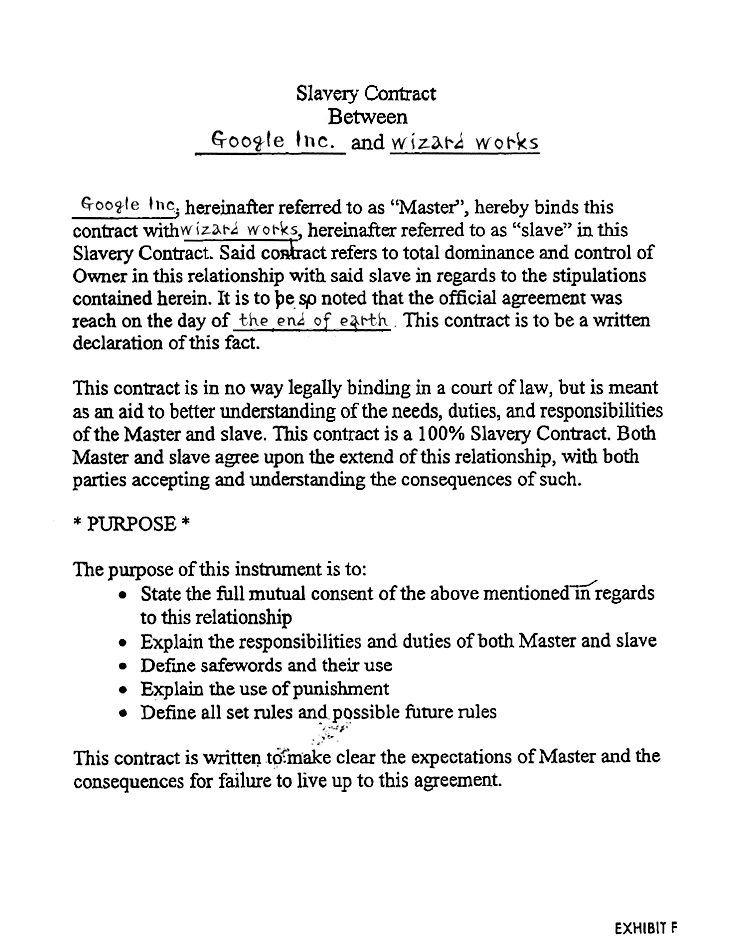
The funny part is, they also put up what they claimed was "a copy of M&A contract with Google", which is titled as "Slavery Contract".
TAG April Fool's Day, , Wizard
(Via Hatena) Nielsen/NetRatings Japan announced Google is now #2 in Japanese market, surpassing Rakuten, in terms of number of users. These are cross-property figures, meaning the # of Google users include Youtube users as well.
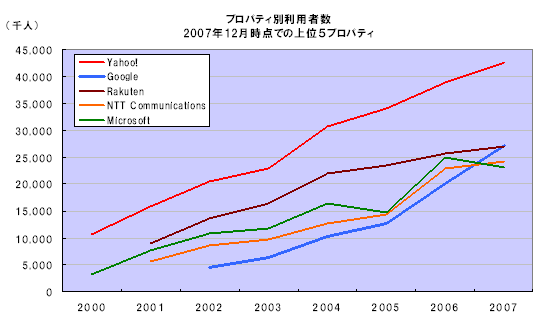
When I was in Japan, I saw quite a few Japanese people using Google search. (Google search market share in Japan is estimated around 35%). And also Youtube is very strong in Japan, partly thanks to the service's foreign basis which helps Japanese users go around the tricky Japanese IP/legal issues. Google seem to be doing fairly well in Japan, as IBM and Apple does.
In contrast, Google is not gaining much turf in the neighboring Korean market - although Korea is the world's 6th largest web market, Google has only around 1.5% market share versus local Naver's 70+%.
When I was in Japan, I saw quite a few Japanese people using Google search. (Google search market share in Japan is estimated around 35%). And also Youtube is very strong in Japan, partly thanks to the service's foreign basis which helps Japanese users go around the tricky Japanese IP/legal issues. Google seem to be doing fairly well in Japan, as IBM and Apple does.
In contrast, Google is not gaining much turf in the neighboring Korean market - although Korea is the world's 6th largest web market, Google has only around 1.5% market share versus local Naver's 70+%.
TAG , Rakuten,
As the article suggests, Naver Knowledge iN (as well as other Naver Search components) rocks. I use it all the time, including last night when I was trying to figure out the part of the movie "M:I 3" that was unclear to me.
The movie premiered only last night, yet all the answers to any possible unclear plots of the movie were already there at Knowledge iN. You get the picture, right?
I think the success of Naver search has been largely helped by the fact that Korea is a very homogeneous society where people often have very common and shared interests. I mean, every society has its memes and zeitgeist, but I think Korea is a little more special. 48+ million people packed in a small country that's equipped with dead efficient broadband and mobile networks. That's an interesting (and even a bit dangerous) combination.
This means, chances are Naver knows what you want to ask it about. For instance, if Park Ji-Sung (the footballer of Mancester United) scored a goal, then when you type "P" in Naver search, Park Ji-Sung's name comes to the top of automatically suggested keywords list.
People criticize Naver doesn't depend on superb technology as much as it does on human intervention and therefore the service is not highly scalable and can only be thriving in some small, homogenous societies like Korea.
But anyway, when it comes to the Korean market, Naver is here to stay and rule. This leads to an interesting question: Google Korea's next move. Back off? or